
For decades, CNC machining has been defined by precision, repeatability, and skilled operators who know their machines inside and out. But the industry is changing. Labor shortages, rising production demands, and the push for lights‑out manufacturing have created a new reality: shops need automation that’s flexible, affordable, and easy to deploy.
That’s exactly why collaborative robots — cobots — are exploding across the CNC world.
In this first CNCCobots.com article, we’re breaking down what’s driving the shift, what cobots can actually do on the shop floor, and how modern machine shops are using them to stay competitive.
What Exactly Is a CNC Cobot?
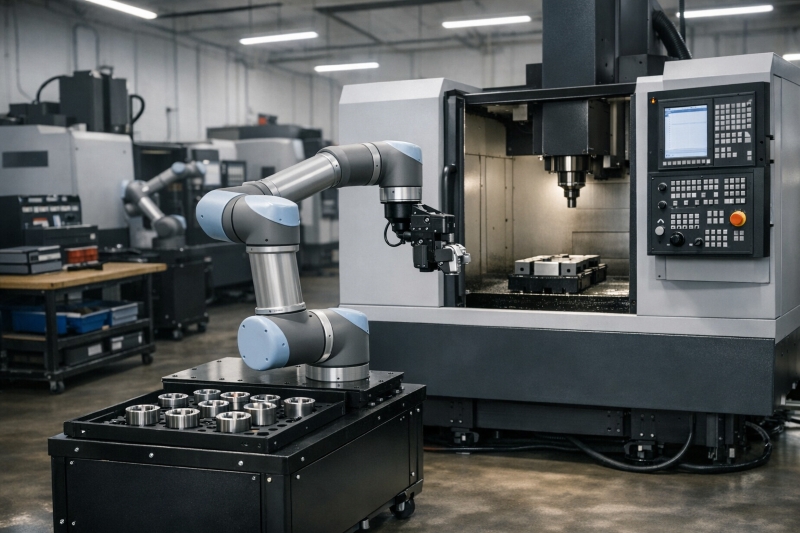
A CNC cobot is a collaborative robot designed to work safely alongside humans while tending CNC machines such as:
- mills
- lathes
- routers
- grinders
- EDM machines
Unlike traditional industrial robots, cobots don’t require cages, complex programming, or six‑figure integration projects. They’re built for:
- quick setup
- flexible redeployment
- small‑batch production
- high‑mix, low‑volume workflows
In other words: they fit the reality of modern job shops.
Why Machine Shops Are Turning to Cobots
1. Labor shortages are hitting every shop
Finding and keeping skilled operators is harder than ever. Cobots don’t replace machinists — they free them from repetitive tasks so they can focus on setups, quality, and throughput.
2. Cobots run lights‑out without the complexity
A cobot can load/unload parts all night with:
- no breaks
- no fatigue
- consistent cycle times
Lights‑out machining used to require expensive automation. Cobots changed that.
3. ROI is faster than most shops expect
Most CNC cobot deployments pay for themselves in 6–18 months, depending on:
- cycle time
- part weight
- spindle utilization
- number of machines tended
For many shops, the ROI is even faster because cobots unlock unused machine capacity.
4. They’re safer and easier to program
Modern cobots use:
- force sensors
- vision systems
- intuitive teach pendants
- drag‑and‑drop programming
This means operators can set up new jobs without calling an integrator.
What CNC Tasks Can Cobots Automate?
Cobots are already handling:
- machine tending
- part loading/unloading
- deburring
- inspection
- palletizing
- tool loading
- post‑process handling
The most common entry point is cobot machine tending, because it delivers immediate spindle‑time gains.
How Cobots Improve Shop Throughput
A well‑deployed cobot can:
- increase spindle utilization from 40–60% to 80–95%
- reduce operator fatigue
- eliminate inconsistent manual loading
- stabilize cycle times
- run unattended shifts
This is why even small shops with 1–3 machines are adopting cobots — not just large manufacturers.
The Real Challenge: Choosing the Right Cobot System
The cobot market is growing fast, and every manufacturer claims to be the easiest, safest, or most flexible. But not all systems are built for CNC environments.
Shops need to evaluate:
- payload
- reach
- cycle time
- gripper compatibility
- machine interface options
- safety requirements
- integration support
- total cost of ownership
That’s where CNCCobots.com comes in.
What You’ll Find on CNCCobots.com
This site is built to be the industry’s most practical, unbiased resource for CNC automation. Here you’ll find:
- cobot comparisons
- machine tending system reviews
- integrator directories
- ROI calculators
- real‑world case studies
- automation workflows
- recommended setups for mills, lathes, and multi‑axis machines
Whether you’re a small job shop or a high‑automation facility, our goal is simple:
Help you choose the right automation — and deploy it profitably.
The Future of CNC Automation Starts Now
CNC cobots aren’t a trend. They’re the new standard for competitive machining.
Shops that adopt automation today will dominate tomorrow.
Shops that wait will struggle to keep up.
CNCCobots.com is here to help you make the right move.