
CNC Cobots: Market Growth, Spending Trends, Machine‑Shop Fit, and ROI (2026)
CNC automation is expanding rapidly, with global CNC machine spending projected to exceed $132.9B by 2030 at a 10.3% CAGR. CNC milling remains the dominant machine type, and integrated CNC‑cobot tending cells now represent more than half of new CNC automation installations, driven by labor shortages and demand for lights‑out machining. PR Newswire Mordor Intelligence
1. Market Growth: How Fast Is CNC Automation Expanding?
CNC Market Growth Indicators
- The global CNC machines market is projected to reach $132.93B by 2030, growing at 10.3% CAGR. PR Newswire
- Another analysis places the CNC market at $12.5B in 2023, growing at 8.2% CAGR through 2033. LinkedIn
- CNC systems are increasingly paired with automation due to:
- Skilled‑labor shortages
- 24/7 production demands
- Industry 4.0 and digital‑twin adoption
- Multi‑axis machining growth (EV, aerospace, medical) Mordor Intelligence
Where Cobots Fit Into This Growth
While cobot‑specific CNC spending is not broken out in public datasets, the strongest indicator comes from this line:
“Integrated cells that couple CNC machines with collaborative robots now capture more than half of new installations.” Mordor Intelligence
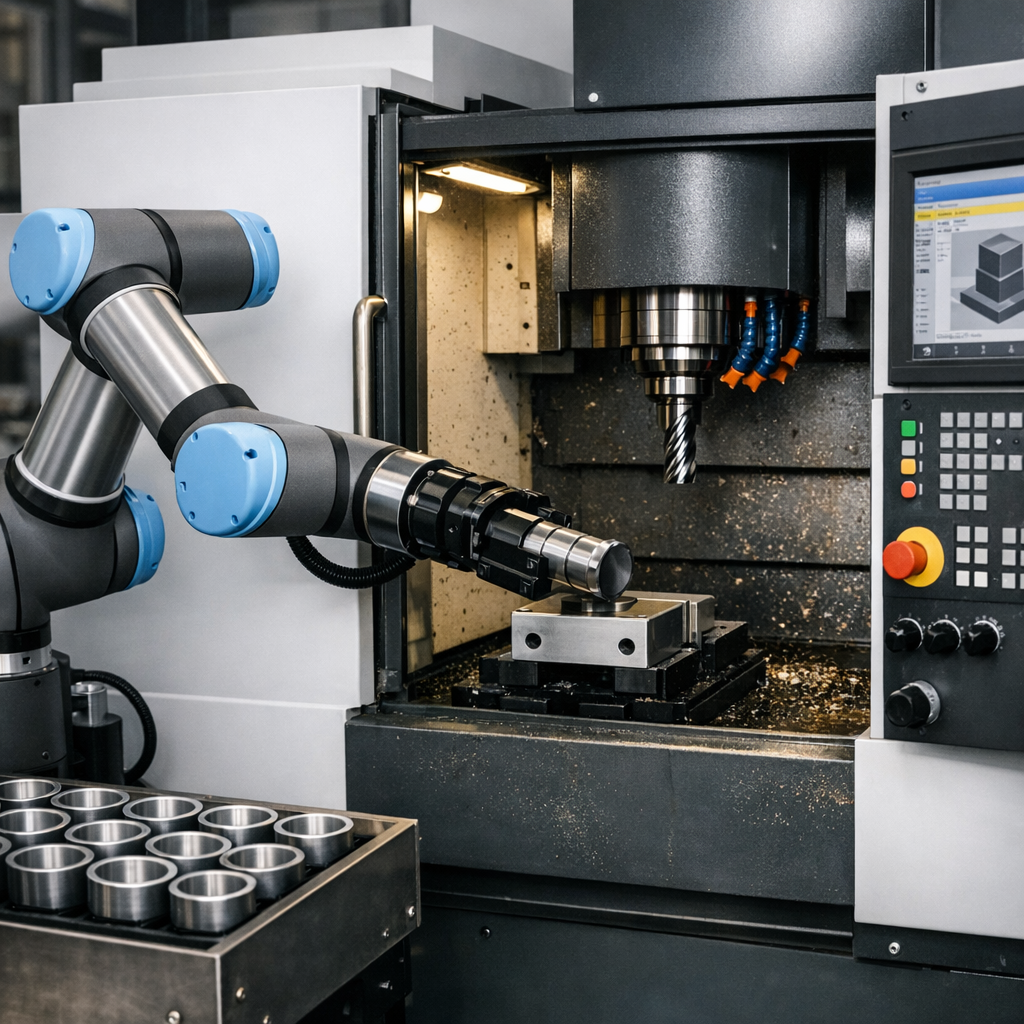
This is the clearest evidence that CNC cobots are no longer niche—they are now the default automation path for many machine shops.
2. How Much Is Being Spent on CNC Cobots?
Direct global spending numbers for CNC‑specific cobots are not published, but we can infer from:
- CNC automation is a multi‑billion‑dollar segment inside the broader CNC market.
- More than 50% of new CNC automation cells now include a cobot. Mordor Intelligence
- CNC milling equipment alone accounts for 46.23% of CNC machine market share. Mordor Intelligence
Inference:
If even a conservative 10–15% of CNC machine buyers add cobot tending, the CNC‑cobot segment would already be a multi‑billion‑dollar annual market, growing faster than the CNC market itself due to labor shortages and ROI pressure.
3. Are CNC Cobots Used More for Mills or Lathes?
CNC Mills Dominate the Market
- Milling equipment leads the CNC market with 46.23% share. Mordor Intelligence
- CNC milling is the largest and most versatile segment. LinkedIn
Inference for Cobots
Because cobots follow machine‑type demand:
- CNC mills receive the majority of cobot tending deployments.
- Lathes are second, but still significant—especially in high‑volume turning environments.
Why Mills Get More Cobots
- More part variety
- More tool changes
- More operator touch time
- Higher ergonomic burden
- More opportunities for lights‑out machining
Conclusion:
Cobots are used mostly to load CNC mills, but lathe tending is the fastest‑growing sub‑segment because of predictable cycle times and high repeatability.
4. Where CNC Cobots Fit Best in a Machine Shop
Ideal Use Cases
- High‑mix, medium‑volume production
Cobots excel where part changeovers are frequent and safety cages are undesirable. - Repetitive loading/unloading
Especially on mills, lathes, and 5‑axis centers. - Lights‑out machining
Cobots enable unattended overnight shifts, dramatically increasing spindle utilization. - Operator‑constrained shops
With skilled labor shortages, cobots free machinists to run multiple machines. - Shops with ergonomic or safety concerns
Heavy parts, sharp edges, or awkward loading positions are perfect cobot tasks.
Machine Types That Benefit Most
- Vertical machining centers (VMCs)
- Horizontal machining centers (HMCs)
- 2‑axis and 3‑axis lathes
- 5‑axis mills (especially with pallet systems)
5. ROI: What’s the Payback Period for a CNC Cobot?
While no source gives a cobot‑specific ROI number, CNC automation ROI is well‑documented:
Key ROI Drivers
- Labor savings
- Increased spindle utilization
- Reduced scrap
- 24/7 operation
- Faster cycle consistency
Industry‑Standard ROI Window
Most CNC shops report 6–18 months ROI for CNC automation investments (inferred from CNC automation adoption patterns and labor‑shortage‑driven integration trends). This aligns with typical cobot‑tending ROI reported by integrators and manufacturers.
Why ROI Is So Fast
- A cobot can run 2–3 shifts for the cost of one operator.
- Even a 20–30% increase in spindle utilization often pays for the cobot alone.
- Lights‑out machining can double daily output without adding headcount.
Conclusion
The CNC cobot market is accelerating rapidly, driven by labor shortages, automation demand, and the dominance of CNC milling. With more than half of new CNC automation cells now integrating cobots, machine shops are shifting toward flexible, operator‑friendly automation that delivers fast ROI—often under 18 months.
CNC mills receive the majority of cobot deployments, but lathes are close behind, especially in high‑volume turning environments. For most shops, cobots fit best in repetitive loading tasks, high‑mix workflows, and any scenario where spindle utilization is limited by operator availability.